
India already has a significant and growing supply of certified green steel, with the main challenge increasingly shifting from availability to creating sufficient demand through public and private procurement, according to an analysis by the Council on Energy, Environment and Water (CEEW).
As of March 31, 2026, around 90 steel producers had received ratings under India's green steel taxonomy, covering 12.40 million mt of certified production. Of this total, approximately 9.0 million mt across 66 producers was rated five-star, 1.33 million mt across 13 producers was rated four-star and around 2.08 million mt across 11 products was rated three-star.
According to CEEW, thermo-mechanically treated bars account for the largest share of certified green steel production at more than 10.02 million mt. The remaining 2.39 million mt includes products such as hot rolled coils, pipes and wire rods.
Green steel taxonomy and CCTS cover different producers
The report underscored differences between India's Green Steel Taxonomy and the Carbon Credit Trading Scheme (CCTS). Green steel certification largely covers downstream finished steel producers, while the CCTS focuses mainly on upstream primary producers such as integrated steel plants and sponge iron facilities. Of the total 12.40 million mt of certified green steel, only eight plants representing 1.69 million mt are also included by the CCTS framework.
CEEW deems the two systems complementary. The certification framework can bolster near-term green steel supply from downstream producers, while the CCTS is expected to propel longer-term decarbonization at primary steelmaking facilities. The weighted-average emissions intensity of currently certified green steel rests at around 1.42 mt of CO₂ per mt of finished steel, below the national green steel threshold of 2.2 mt.
Green Steel Thresholds May Reach 40 Million MT
According to the draft CCTS emissions-intensity targets, CEEW projects that nearly 40 million metric tons of Indian steel production could meet the standards for green steel by 2026-27, provided the obligated entities achieve their targets without resorting to carbon credit purchases. Of this projected production, approximately 24 million metric tons could potentially attain a five-star rating.
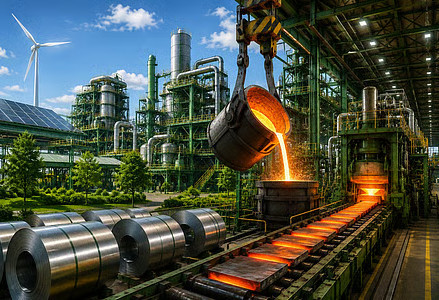
CEEW also indicated that the cost might not be as significant an obstacle as generally perceived. In many instances, certified green steel is already available at competitive rates. Implementing energy-efficiency measures and using renewable electricity can decrease steel emissions intensity by about 8-15 percent without necessarily increasing production costs. Even if a price premium exists, the report predicts that its effect on the total costs of infrastructure projects will be minimal.
CEEW Emphasizes Importance of Quality Considerations
The issue of quality remains complex, particularly given that a significant portion of certified green steel is produced using scrap-based induction furnace methods. The CEEW indicates that these production methods may face quality limitations for specific applications compared to blast furnace or gas-based direct reduced iron production. Consequently, the report recommends aligning the procurement of green steel with the quality requirements of the final product. It also encourages investments in advanced scrap processing and secondary steelmaking technologies to improve quality.
CEEW Urges Increased Green Steel Procurement
CEEW has noted that India has already established a green steel taxonomy, systems for measurement, reporting, and verification, as well as certification through the National Institute of Secondary Steel Technology. However, progress on demand-side policy has been relatively slow.