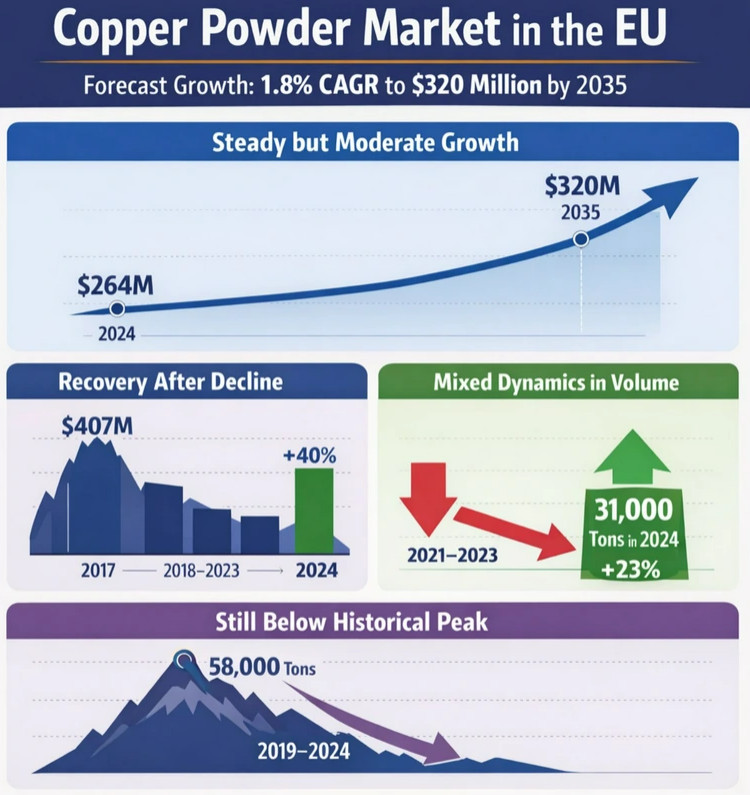
The copper powders and flakes bazaar inside the European Union is mentioned to have encountered a resurgence in consumption in 2024. Reaching 31, 000 tons ($264 million) after a previous two-year decline, though this figure remains underneath the summit witnessed in 2018.
Notably, Germany appears as the main purchaser and manufacturer in this market. Estimations suggest an humble expansion path, with the market anticipated to expand to 36, 000 tons ($320 million) by the year 2035. Thorough information breakdowns by country are provided for consumption, production, imports, and exports, underscoring Germany's control in terms of value, Italy's notable function in manufacturing, and the swift growth in significant operations observed in Belgium. The examination additionally explores into commerce arrangements involving different product types (non-lamellar vs. lamellar powders) and tracks price trends. The marketplace for copper powder within the European Union is ready for a surge in reaction to increasing demand, with consumption levels anticipated to rise steadily over the coming decade. Predictions indicate a slight increase in market efficiency, with an estimated Composite Annual Growth Rate (CAGR) of +1.1% forecasted for the period spanning from 2024 to 2035. This expansion path is anticipated to climax in a market volume of 36, 000 tons by the conclusion of 2035.
Copper Powder Market Growth and Trends 2024-2035
European Countries Lead in Consumption and Growth
- Germany, Italy, and France had the highest volumes of consumption in 2024
- France had the biggest increase in consumption from 2013 to 2024
- Germany led the market in value terms, followed by Italy and then France
- Germany had the highest growth rate in value from 2013 to 2024
- Bulgaria, Germany, and Austria had the highest levels of copper powder per capita consumption in 2024
- Poland had the most notable rate of growth in consumption from 2013 to 2024
European Union's Declining Copper Powder Production
The European Union underwent a successive third-year decline in copper powder and flakes manufacturing, with a -1.5% drop to 33, 000 tons in 2024. While exhibiting a generally stable trend, an remarkable increase surge of 30% was observed in 2021. The peak production volume of 55, 000 tons was reached in 2018, with following years indicating lower output levels. The approximated export value valuation of copper powder production reached $408 million in 2024. Despite the fluctuations, the complete manufacturing pattern remained relatively stagnant, with a substantial expansion rate of 62% recorded in 2021. The manufacturing quality struck a peak level of $516 million in 2018 but declined in the following years until 2024.
Key Trends in Copper Powder Production and Imports
- Countries with highest production volumes in 2024: Germany (14K tons), Italy (9.9K tons), Spain (4.3K tons)
- These countries comprised 84% of total production
- France, Poland, and Slovakia lagged behind, accounting for a further 16%
- Slovakia experienced the biggest increase in production from 2013 to 2024, with a CAGR of +9.4%
- Purchases abroad of copper powders and flakes increased by 18% to 21K tons in 2024
- Imports of copper powders and flakes had a flat trend pattern over the period
- Copper powder imports peaked at 24K tons in 2016
- Copper powder import value expanded to $239M in 2024
- Imports had a relatively flat trend pattern in value terms
- The most significant growth rate for imports was recorded in 2021, with a 61% increase
- Import value peaked at $257M in 2022, but decreased slightly in 2023 and 2024
German Lead in Copper Imports, Belgium Stands Out
In 2024, Germany led in importing copper dusts and chips with 6K tons, followed by Italy with 3.6K tons. Other notable importers comprised Belgium, France, Bulgaria, Austria, Sweden, and Spain, making up 91% of entire imports. Belgium stood out with an extraordinary Annual Compound Increase Speed (CAGR) of +25.5% from 2013 to 2024, while the other leading countries experienced slower growth rates in their purchases. In relation to import worth, Germany, Italy, and France were the leading purchasers in 2024, totaling $147M. Austria, Sweden, Bulgaria, Spain, and Belgium represented for an extra $53M in purchases. Belgium notably saw a CAGR of +6.9% in import value, exhibiting the highest growth rate among the major importing countries throughout the time examined, while the other leading countries encountered increased restrained growth rates.
- Copper powders of non-lamellar structure prevailed in imports in 2024, reaching 19K tons (90% of total imports).
- Copper powders of lamellar structure, flakes followed at 2.1K tons (9.9% share of total imports).
- Imports of copper powders of non-lamellar structure showed a relatively flat trend in volume.
- Imports of copper powders of lamellar structure, flakes also showed a relatively flat trend in volume.
- The largest types of copper powders and flakes had stable market shares over the analyzed period.
- Copper powders of non-lamellar structure were the largest type in value terms, at $217M (91% of total imports).
- Copper powders of lamellar structure, flakes held the second position in value at $22M (9.2% share of total imports).
- Imports of copper powders of non-lamellar structure remained stable from 2013-2024.
European Union Import Price Trends 2013-2024
- The import price in the European Union was positioned at $11,207 per ton in 2024, showing a decrease of -5.6% compared to the previous year.
- The arrival cost exhibited a relatively stable trend overall, with the most significant growth rate observed in 2021 at 46%.
- Import costs reached $11,936 per ton in 2022 but experienced a slowdown from 2023 to 2024.
- In 2024, the highest-priced product was copper in the shape of powders with a non-lamellar structure, priced at $11,292 per ton, while bronze within the variety of powders with a lamellar structure and flakes was priced at $10,435 per ton.
- From 2013 to 2024, the most notable price development was noticed in copper powders with a non-lamellar structure, increasing by 0.8%.
- In 2024, the import cost in the European Union was $11,207 per ton, marking a 5.6% decline from the prior year, with the most significant growth seen in 2021 at 46%.
- Import costs reached their highest point at $11,936 per ton in 2022 but showed a slowdown from 2023 to 2024.
- There were substantial price variations among the principal importing nations, with France having the highest import cost at $15,531 per ton and Belgium having one of the lowest at $2,460 per ton.
France leads in copper powder exports growth
Between 2013 and 2024, France achieved the greatest price increase rate of +4.3%, exceeding other prominent nations. In 2024, the European Union observed a reduction in copper powders and chips exports to 23K tons, marking a -12% decline from the previous year. Notwithstanding a mean yearly export quantity growth of +1.6% over the period, there were observable variations, with 2021 showing the most significant growth of 42%. The exports peaked at 27K tons in 2023 but decreased in 2024. The worth of copper powder exports significantly increased to $266M in 2024, with a typical yearly growth rate of +1.7% from 2013 to 2024. Important changes were noticed throughout this period, with the most rapid growth of 73% occurring in 2021, reaching a summit of $277M. However, from 2022 to 2024, export expansion rates stayed decreased.
Key European Union Copper Powder Exporters in 2024
In the year 2024, Germany and Italy surfaced as the leading copper powder and chips exporters within the European Union, accounting for approximately 62% of the total exports. Coming directly after was Spain, securing the second position with an 11% share of the total exports, followed by Belgium and France. Lesser contributors, Slovakia and Poland, each grasped a 4.6% share of the total exports. Amidst the foremost exporting countries, Slovakia showed the utmost substantial increase pace within shipments from 2013 to 2024, achieving a Compound Annual Growth Rate (CAGR) of +19.7%, surpassing the expansion speeds of other leading exporters. In regards to worth, Germany held its stance as the largest supplier of copper powder within the European Union, representing 52% of the total exports by value. Italy came in second position, with a 25% portion, and France in third place with a 9.3% share. Throughout the duration of 2013 to 2024, Germany went through a fairly moderate average annual growth rate in value. Italy demonstrated a typical yearly expansion rate of +0.8%, whilst France witnessed a decline of -10.4% per year.
Overview of Copper Powder Exports to EU 2013-2024
Сopper in the shape of dusts with a non-lamellar structure was the most important item sent overseas, totaling approximately 17, 000 tons, which accounted for 74% of the overall exports. Following this, copper dusts with a stratified configuration and fragments reached 6, 100 tons, representing 26% of the entire exports. The shipment quantity of copper dusts with a non-lamellar structure remained relatively consistent over time. Conversely, there was an affirmative growth trend of +4.0% in the export quantity of copper powders with a layered configuration and pieces. Specifically, this category encountered the greatest expansion pace amidst bronze powder exports out the European Union, displaying a Composite Yearly Growth Rate (CAGR) of +4.0% from 2013 to 2024. Whilst the portion of copper dust with a plate-like arrangement and chips increased significantly by 6 percentage points in total exports from 2013 to 2024, the share of copper powders with a non-lamellar framework reduced by 6 percent. In terms of value. Copper powders with a non-lamellar structure, amounting to $211 million, retained its status as the most precious kind of bronze powders and flakes sent to the European Union, constituting 79% of the total exports. In contrast, copper dusts with a stratified formation and shavings, valued at $55 million, held a 21% share of the entire exports, obtaining the runner-up spot in the ranking. The shipments of copper powders with a non-lamellar structure experienced an average annual growth rate of +2.4% between 2013 and 2024.
In 2024, the export cost inside the European Union reached $11, 413 per ton, marking a substantial 22% ascend in relation to the previous year. Despite this increase, the export cost has usually showed a secure trend over time. The most remarkable increase in export cost happened in 2017, with a significant 23% surge. 2024 recorded the topmost export price level, indicating a favorable path for future growth in the export market.
Export Price Trends in European Union Copper Powder Industry
Throughout the years, the export cost has typically demonstrated a stable trend, with a notable surge of 23% observed in 2017. The export value struck its zenith in 2024, indicating a potential for continuous growth in the future. Important fluctuations in mean prices were evident among the primary exporting nations. Germany stood out with the utmost price at $16, 625 per ton in 2024, whilst Slovakia had one of the lowest at $1, 391 per ton. During the duration of 2013 to 2024, France displayed the most outstanding cost growth at 12.2%, surpassing other prominent exporters in terms of price increase. This examination provides a thorough summary of the copper dust sector within the European Union, focusing on demand, supply, and commerce kinetics inside the regional value chain. It explores the impact of request from important sectors and end-user sections concerning usage patterns, while also highlighting the impact of resource availability, production efficiency, and regulatory frameworks on supply dynamics.